Filament
TPU
Flexible parts: cases, gaskets, dampers, straps. Rubber-like filament.
Select printer
Material passport
Nozzle210–240 °C
150°300°
Bed30–60 °C
0°120°
Density1.2 g/cm³
Requirements & properties
Drying
Encyclopedia
TPU (thermoplastic polyurethane) is a flexible, rubber-like material. The finished part stretches, bends and springs back without breaking. Stiffness is set by Shore hardness: 85A is soft like an eraser, 95A is springy and closer to hard rubber. TPU is harder to print than rigid plastics because of its soft strand.
What it is good for
- Phone cases, protective bumpers
- Gaskets, seals, dampers
- Straps, hinges, flexible joints
- Wheels, treads, anti-vibration feet
Where NOT to use it
- Rigid loaded parts — TPU is too soft
- High speed on a Bowden extruder — the strand buckles and skips
- Tight-tolerance dimensional parts — flexibility hurts accuracy
- Small parts with sharp geometry — TPU rounds them off
How to print
- Nozzle temperature: 210–240 °C
- Bed temperature: 30–60 °C
- Cooling: 30–100% depending on hardness
- Speed: 15–40 mm/s — slow! TPU hates rushing
- Extruder: direct drive preferred; on Bowden, only rigid 95A and very slow
- Retraction: minimal (0.5–2 mm) — or the strand jams in the extruder
Drying and storage
TPU is very hygroscopic — it absorbs moisture fast. Wet TPU bubbles, hisses, and loses elasticity.
- Drying: 50–60 °C for 6–8 hours (before every print if the spool sat open)
- Storage: airtight box with silica gel — strictly
- Signs of moisture: bubbling, hissing, heavy stringing, brittle part
Pros and cons
- Flexible and elastic, springs back well
- Wear-resistant, resists oils and abrasion
- Absorbs vibration and impact
- Available in different hardnesses
- Hard to print — needs low speed
- Works best on direct drive
- Very hygroscopic
- Prone to stringing
FAQ
Rigid TPU (95A and up) yes, but very slowly (15–25 mm/s) with minimal retraction. Soft TPU (85A) barely prints on Bowden: the strand buckles in the tube instead of feeding. Soft TPU needs direct drive.
Lines
Filament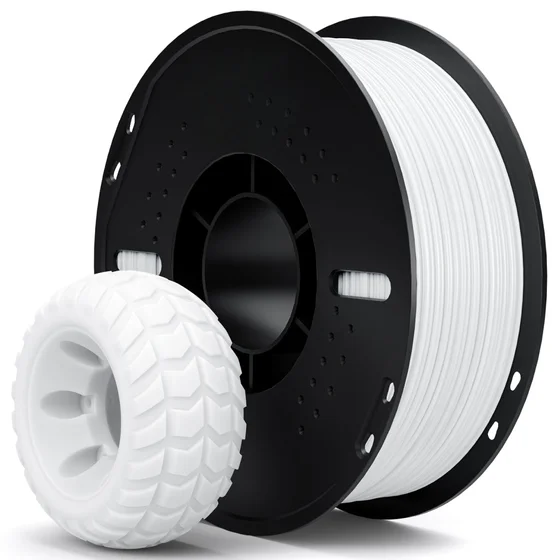
ELEGOO TPU 95A — Flexible TPU Filament
TPU · Standard
Nozzle210–230 °C
150°300°
+1
AliExpress$21Реклама · erid: 2SDnjbw1fh4
Filament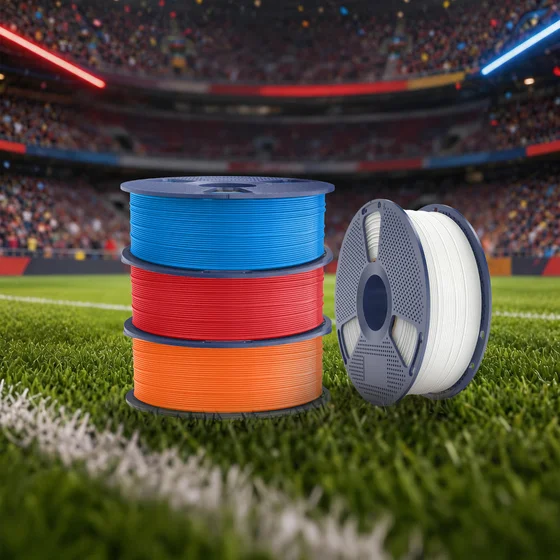
SUNLU TPU 90A/95A — Flexible Filament
TPU · Standard
Nozzle190–240 °C
150°300°
+1
AliExpress$30,52Реклама · erid: 2SDnjf4Ddvi
Filament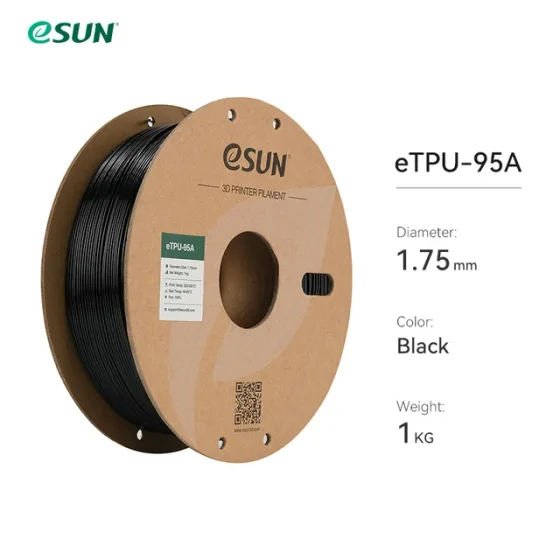
eSUN eTPU-95A — Flexible Filament
TPU · Standard
Nozzle220–260 °C
150°300°
+1
AliExpress$24,41Реклама · erid: 2SDnjc1UyAA