Filament
PLA-CF
Stiff, light parts with a matte finish: frames, housings, carbon-look decor.
Select printer
Material passport
Nozzle210–230 °C
150°300°
Bed40–60 °C
0°120°
Density1.3 g/cm³
Requirements & properties
Hardened nozzle
Encyclopedia
PLA-CF is regular PLA with chopped carbon fiber added. The fiber makes the part noticeably stiffer and more dimensionally stable, and gives a pleasant matte, carbon-look surface that hides layers. It prints almost like regular PLA but needs a hardened nozzle: carbon fiber is abrasive and quickly wears down brass.
What it is good for
- Stiff light parts where plain PLA is too flexible
- Housings and frames, drones, mounts — premium matte surface
- Carbon-look decor
- Parts where dimensional stability matters
Where NOT to use it
- Printers with a brass nozzle and no swap — carbon fiber wears it out in a few spools
- Loaded parts under heat — heat resistance is still PLA-level (~55–60 °C)
- Impact loads — carbon fiber makes PLA-CF even more brittle
- Thin flexible parts — the part becomes brittle
How to print
- Nozzle temperature: 210–230 °C (a touch above plain PLA)
- Bed temperature: 40–60 °C
- Nozzle: hardened (steel) from 0.4 mm; brass wears out from the abrasive
- Cooling: 100% after the first layers
- Speed: 40–100 mm/s
- A 0.4 mm nozzle can clog — 0.5–0.6 mm is better for CF
Drying and storage
PLA-CF is slightly more hygroscopic than plain PLA due to the filler, but generally not critical.
- Drying: 45–55 °C for 4–6 hours if needed
- Storage: dry box with silica gel
- Signs of moisture: extra stringing, brittle rough surface
Pros and cons
- Stiffer and more stable than plain PLA
- Attractive matte carbon-look surface, hides layers
- Lightweight
- Prints almost like regular PLA
- Needs a hardened nozzle (abrasive)
- More brittle than PLA
- Heat resistance no better than plain PLA
- Prone to clogging small nozzles
FAQ
The carbon fiber is very abrasive and wears soft brass in a few spools. A worn nozzle changes the bore diameter, flow drifts, and quality drops. Use a hardened steel nozzle, ideally 0.5–0.6 mm.
Lines
Filament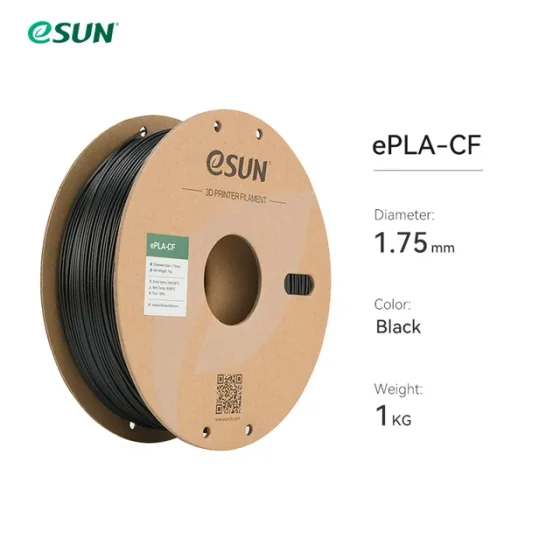
eSUN ePLA-CF — Carbon-Fiber PLA Filament
PLA-CF · Matte
Nozzle190–230 °C
150°300°
AliExpress$14,86Реклама · erid: 2SDnjeyTCNE