Flashforge Creator 5 vs Snapmaker U1: Budget Tool Changer Showdown 2026
A comparison of 2026's two most affordable tool changers. By June both are shipping and reviewed. We break down price, swap speed, waste, firmware and nozzles — and which to buy.
2026 is the year tool changers finally went mainstream. These printers swap entire toolheads mechanically instead of feeding different filaments through a single nozzle, which means near-zero waste and true multi-material printing. Two budget contenders are fighting for dominance: the Snapmaker U1, which scored 4.5/5 from Tom's Hardware, and the Flashforge Creator 5, which launched in spring 2026 and now has its first independent reviews. So this is now a comparison of two real, shipping machines.
What Is a Tool Changer and Why Should You Care
Quick primer: a tool changer has multiple independent toolheads that the printer swaps automatically during a print. Unlike AMS-style systems where one hotend switches between filaments (wasting tons of plastic on purge towers), a tool changer just parks one head and picks up another. The result? Far less waste and the ability to print different materials (PLA + PETG + TPU + PVA) in a single model.
Real-world example from a 3DToday review: the same multicolor shark model used 22g of filament on the U1 vs 204g on an AMS printer. That's nearly 10x less waste. That's the whole pitch for tool changers in one number.
Specs Comparison
| Spec | Snapmaker U1 | Flashforge Creator 5 |
|---|---|---|
| Status | Shipping, widely reviewed | Shipping since May 2026, first reviews |
| Price | $849–999 | $649 (launch) / $799 MSRP |
| Build Volume | 270 × 270 × 270 mm (19.7L) | 256 × 256 × 256 mm (16.8L) |
| Toolheads | 4 | 4 |
| Tool swap | ~5–12 sec | ~4–6 sec |
| Motion System | CoreXY (carbon fiber rails) | CoreXY |
| Print Speed | 300 mm/s | 300 mm/s |
| Travel Speed | 500 mm/s | 600 mm/s |
| Acceleration | 20,000 mm/s² | 30,000 mm/s² |
| Max Nozzle Temp | 300°C | 320°C |
| Max Bed Temp | 100°C | 120°C |
| Nozzles | 0.4 mm | 0.25 / 0.4 / 0.6 / 0.8 mm |
| Enclosure | Open (top cover $249) | Open (Pro is enclosed, 65°C) |
| RFID spools | Yes | No (manual loading) |
| Firmware | Klipper (open source) | Proprietary (Orca-Flashforge) |
| Slicer | OrcaSlicer | Orca-Flashforge, OrcaSlicer |
| Noise | 55 dB (49 with cover) | ~65 dB (Pro ~55) |
| Weight | 18.2 kg | 14 kg |
| Power | 1150W | 700W |
Snapmaker U1: What Reviewers Actually Say
The U1 is one of the most reviewed printers of 2026. It raised $20.16M on Kickstarter from 20,206 backers (the goal was $100K -- they exceeded it by 200x). And crucially, post-launch reviews confirmed the hype rather than deflating it.
- Tom's Hardware 4.5/5 -- "Best multi-color 3D printer", verified 5–12 second swaps, excellent auto bed leveling
- TechRadar 4.5/5 -- "Most exciting 3D printer to date", multi-material speed validated
- 3Dnatives 9/10 -- professional lab testing methodology, multi-material capabilities confirmed
- 3DPrint.com -- 300+ hours of testing with no defects, first layer nearly as good as Prusa XL
- All3DP -- "Make Haste Not Waste" -- waste reduction confirmed in testing
The cons reviewers flagged: open frame means ABS/ASA/nylon need the $249 top cover add-on, plastic housing feels thin with some QC concerns, only 0.4mm nozzle with no diameter options, Wi-Fi bugs after firmware updates, no spool moisture protection, and 55 dB noise without the cover.
Flashforge Creator 5: What the First Reviews Show
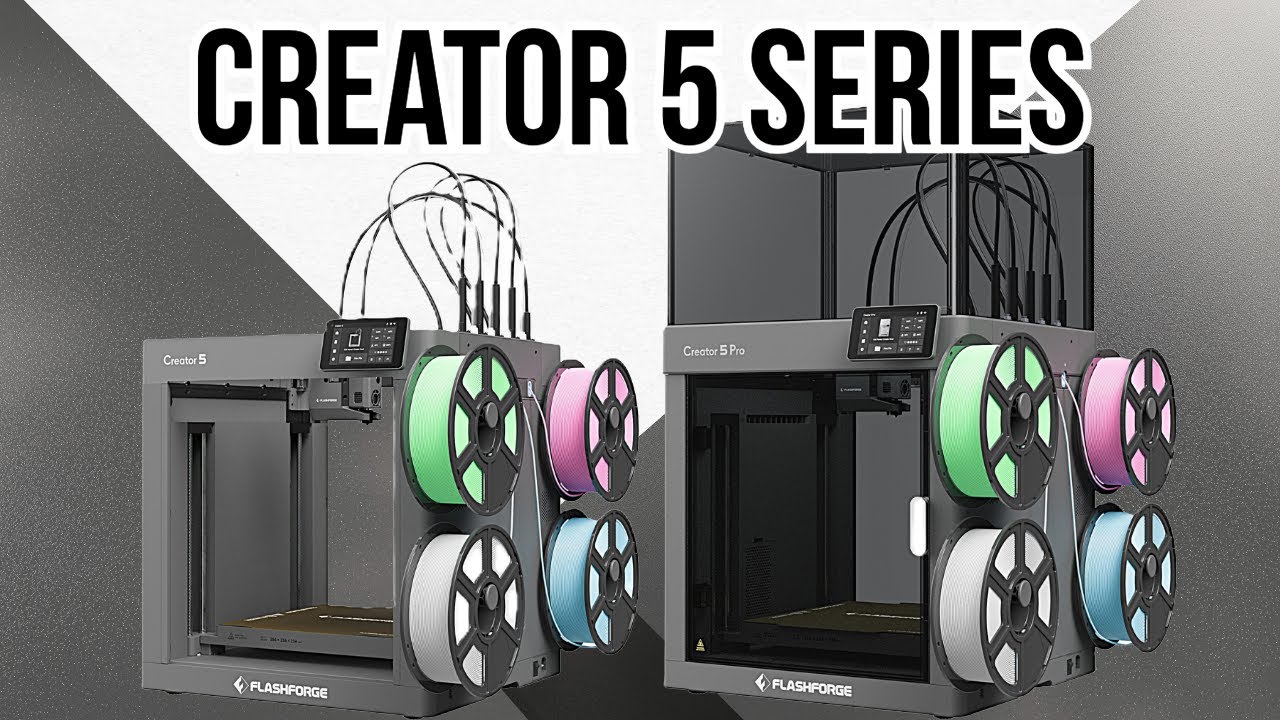
Flashforge positions the Creator 5 as the cheapest 4-head tool changer on the market. The FlashSwap system parks the heads on the right side and, per FauxHammer's measurements, swaps a tool in roughly 4–6 seconds (the TCT Asia demo showed ~7s). It also supports multiple nozzle diameters (0.25/0.4/0.6/0.8mm), a genuine advantage over the U1's 0.4mm-only setup.
The specs are solid: 30,000 mm/s² acceleration, 600 mm/s travel, bed temp up to 120°C. First reviews praise the out-of-the-box print quality -- a clean Benchy and good PEI adhesion. There's a Creator 5 Pro with a fully enclosed heated chamber up to 65°C and HEPA filtration -- it costs $799 at launch and $949 MSRP. The base Creator 5 started at $649, with shipping from May 2026.
What reviewers flagged as downsides: proprietary Flash Studio firmware instead of open Klipper, manual filament loading with no RFID, manual nozzle swaps, and no waste chute (scraps drop inside the chassis). Flashforge's mixed software track record is a concern (something Anton Mansson noted in his breakdown), and the ecosystem isn't as polished as Bambu's. Noise on the open version is around 65 dB.
Key Differences Beyond the Spec Sheet
Both printers are shipping now, so the choice comes down to a few fundamental differences.
- Price: the Creator 5 is cheaper -- from $649 (launch) vs $849 for the U1. At retail it's $799 for the Creator 5 vs $899–999 for the U1, so the Creator 5 stays more affordable.
- Firmware: the U1 runs Klipper -- open source, huge community, full customization. The Creator 5 is proprietary (Orca-based slicer). For power users, that's a real mark against the Creator 5.
- Enclosure: both are open-frame at base. The Creator 5 has a Pro version with a heated chamber up to 65°C, HEPA filtration and ABS/ASA/nylon support ($799/$949). The U1 has an optional $249 top cover with passive heating.
- Nozzles: the Creator 5 offers 0.25/0.4/0.6/0.8mm swappable nozzles. The U1 is 0.4mm only for now. For engineering applications, this matters.
- Build volume: the U1 wins -- 270mm cube vs 256mm. Small difference, but 19.7L vs 16.8L is 17% more volume.
- Ecosystem: the U1 has RFID spool recognition and an AI camera, with a Klipper/OrcaSlicer stack. The Creator 5 uses an Orca-based slicer (Orca-Flashforge), but there's no RFID -- spools are assigned manually.
Waste and Speed: What Held Up
The killer advantage of tool changers over AMS/MMU systems is waste reduction. U1 reviewers confirmed it: the same multicolor print that uses ~204g on an AMS printer used just 22g on the U1. That's 80%+ filament savings -- not marketing, but verified fact.
On speed: a 3-color print on the U1 added 24 minutes for tool swaps, while AMS added 2.5 hours for purging. The Creator 5 also markets "zero purge" waste, but the first reviews confirmed it still prints a small prime tower to settle pressure -- waste isn't zero, but it's far lower than single-nozzle systems. By Flashforge's benchmark a multicolor Rubik's cube prints in 2.6h and 47.5g vs 16h and 290g on a purge system (-84%), and in FauxHammer's review a two-color dragon finished in about 5 hours.
Click to load YouTube content
Flashforge Creator 5 / 5 Pro reveal
Which Tool Changer Is Right for You?
Here's an honest decision framework:
Market Context: Other Tool Changers in 2026
The U1 and Creator 5 aren't the only options. The tool changer market is heating up fast:
- Prusa XL 5-tool ($3,699+) -- the proven gold standard, but 4x the price
- Bambu Lab H2C ($2,399) -- technically a hot-end swapper, not a true tool changer. Different approach, premium price
- Prusa INDX on CORE One (~$700 total) -- expected Q1-Q2 2026, budget option from Prusa
- AtomForm Palette 300 ($999–2,199) -- 12 nozzles, pre-order. Ambitious project
FAQ
The Verdict
By June 2026 both printers are real, shipping machines, and the comparison is finally fair. The Snapmaker U1 is the choice proven by many reviews: 4.5/5 from major outlets, open-source Klipper firmware, RFID and an AI camera. The Flashforge Creator 5 is the cheaper, newer challenger: early reviews praise its print quality and swap speed, it offers swappable nozzles and an enclosed Pro version, but its ecosystem and software still trail the U1 and it has fewer independent tests.
Our recommendation: if you want the most proven, open platform, get the U1. If price, swappable nozzles and an enclosed chamber (the Pro) matter more, look at the Creator 5 -- it's shipping now and earning positive early reviews. For the full breakdown, see our Flashforge Creator 5 review.
Printer Hub Team
We study official documentation and manufacturer guides, test mods on real printers, and analyze community experience from Reddit, Discord, Printables, and YouTube.
Your printer, in reach from anywhere
Remote access to Klipper and OctoPrint, AI print monitoring and your own model library — on a VPS from 172 ₽ for the first month.
- NVMe drives
- Anti-DDoS
- 24/7 support
- 🇷🇺 🇩🇪 🇳🇱 7 locations
First month with the promo code, then from 429 ₽/mo — Promo plan: 2 GB RAM, 30 GB NVMe, backups included.
Buying via this link supports Printer Hub 🤝